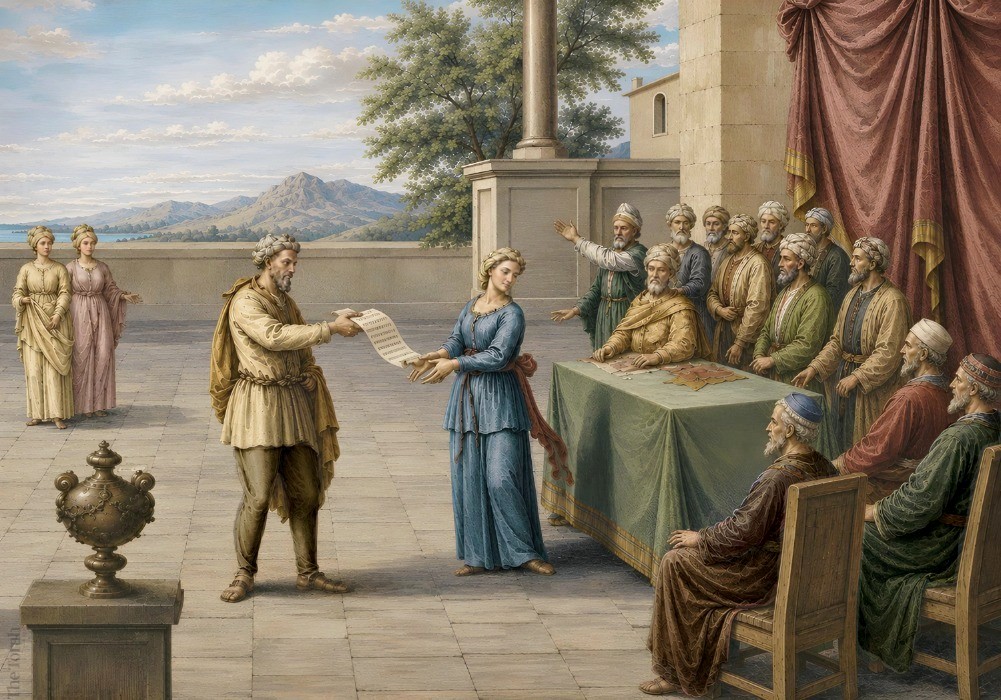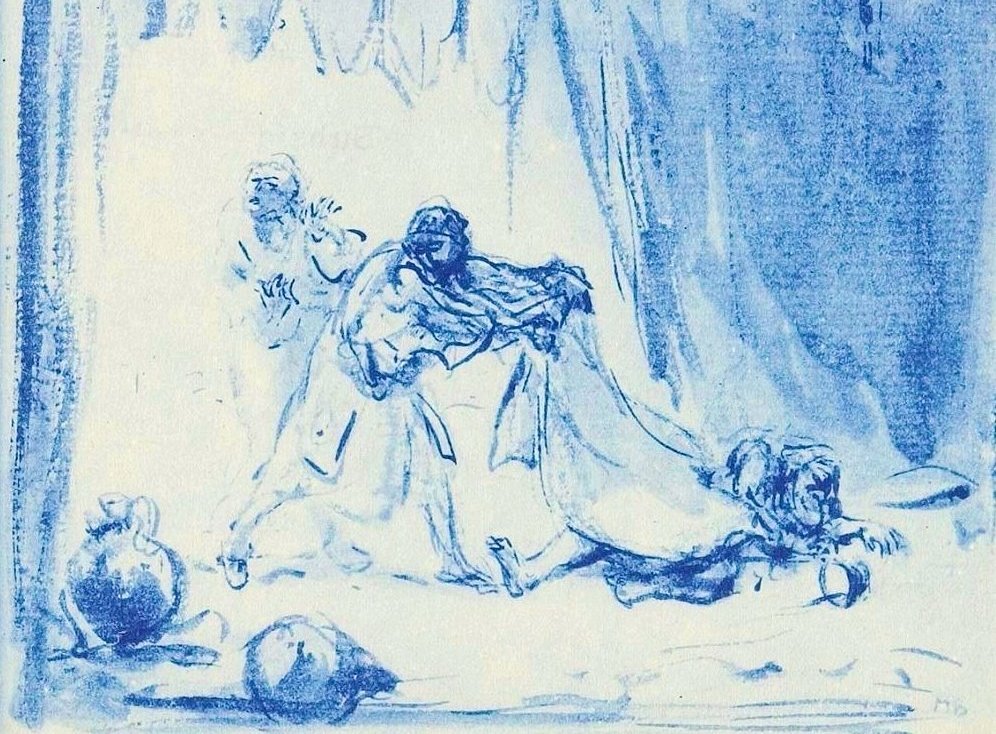
Shem and Japhet Cover Noah, Marius Bauer 1882-1914. National Library of the Netherlands
A new solution to why Canaan (not Ham) was cursed.
Shem and Japhet Cover Noah, Marius Bauer 1882-1914. National Library of the Netherlands
Published October 18, 2017
See b. Sanhedrin 70a:
רב ושמואל, חד אמר: סרסו, וחד אמר: רבעו.
Rav and Samuel: One said “He castrated him,” the other said, “He took advantage of him sexually.”
See also, Rashi to Gen 9:22.
The NET translation of וידע נח as “Noah learned” cited above is a forced attempt to address this difficulty.
It is worth noting that Sodom (Gen 19) and the Benjaminites at Gibeah (Judg 19-21) are also depicted as homosexual rapists (though not practitioners of incest), and both are destroyed for their iniquities (by God and the Israelites respectively).
For this reason, Oxford biblical scholar John Day has recently rejected the homosexual rape interpretation. See John Day, From Creation to Babel: Studies in Genesis 1-11 (Bloomsbury, 2013).
Indeed, even the original text was squeamish about the matter and preferred using the euphemism of “seeing nakedness” and the indirect “what his son did to him.”
True, the curse of Canaan bestows the status of master to his unnamed brothers. Yet this does not necessitate a narrative presentation of a uniquely meritorious act that they performed in order to deserve this. All that is required in terms of narrative is to show that Canaan “earned” his curse.
In his “How the Canaan Curse Conundrum Came to Be,” (TheTorah.com [2015]), Zev Farber notes the awkwardness of phrase “Ham is the father of Canaan” and suggests that original story didn’t have Ham at all, and that this was added to make this non-Priestly story work with the Priestly framework of Shem, Ham, and Japhet being Noah’s sons. Similarly, Tzemah Yoreh argues that Noah originally had four sons, and that Canaan was demoted in the redaction; see Tzemah Yoreh, “Noah’s Four Sons,” TheTorah.com (2014).
The theory goes on to posit that this original story must have thought of Noah as having three sons, the youngest of which was Canaan. And since, as we are told, Shem and Japhet covered their father’s nakedness and were subsequently blessed, Shem, Japhet and Canaan must have been Noah’s “My Three Sons.” Theoretically, this makes perfect sense. On the other hand, it implies a conception of Canaan as brother of Shem similar to the way that Genesis presents Esau/Edom as the brother of Jacob/Israel. The problem with this is that there is very little evidence of a conception of Israelite kinship with the Canaanites in biblical literature. On the contrary, biblical literature points to various degrees of familial kinship with the Ishmaelites (through Abraham’s concubine), the Ammonites and Moabites (through Abraham’s nephew, Lot), the Arameans (cf. ארמי אבד אבי of Deut 26 and the marriage of Isaac and Rebecca) and the Edomites (=Esau), but not the Canaanites! Yet according to the theory of the original story of Gen 9 as generally presented, Noah’s curse against Canaan enacted the enslavement of the Canaanites to their “brother,” the Shemites (including, of course, Israelites), just as Isaac’s blessing, though given unwittingly, determined the subordination of the Edomites to their Israelite brethren. While it is possible that the original story of Gen 9 simply reflects a unique tradition of familial brotherhood between Israel and Canaan that was denied or suppressed by the dominant biblical tradition, the anomaly should give us reason to pause and wonder if this is really the best solution.
This also caused the redactor to add Canaan into v. 18 artificially, as a way of introducing him to the reader before the genealogies, to make the newly placed story comprehensible.
בראשית ט:יח וַיִּהְיוּ בְנֵי נֹחַ הַיֹּצְאִים מִן הַתֵּבָה שֵׁם וְחָם וָיָפֶת
וְחָם הוּא אֲבִי כְנָעַן.
ט:יט שְׁלֹשָׁה אֵלֶּה בְּנֵי נֹחַ וּמֵאֵלֶּה נָפְצָה כָל הָאָרֶץ.
Gen 9:18 The sons of Noah who came out of the ark were Shem, Ham, and Japheth.
Ham was the father of Canaan.
9:19 These three were the sons of Noah, and from them the whole earth was populated.
I have no clear explanation for why the editor deemed it appropriate to present Canaan as slave to Japhet. Was he aware of Canaanite slavery in Greece?
Jacob finds no fault with Bilhah. Presumably, she was thought of as powerless, both physically and with regard to her lowly status, to fend off the future head of the clans of Jacob, though the incident would likely result in her being barred from Jacob’s bed (cf. Deut 24:1-4; 2 Sam 20:3). But the narrator does not appear to show interest in her concerns or plight. He does not even emphasize that rape was involved. This, it seems to me, is because Reuben’s offence against his father is not affected by the question of Bilhah’s complicity in the act.
Sleeping with a ruler’s (or a father’s) concubine is a way of asserting one’s own position as heir or ruler; Avshalom takes his father David’s concubines (2 Sam 16:21-22); Solomon executes his brother Adoniyah for asking to marry David’s final concubine, Avishag (1 Kings 2:17-22); Ish-Boshet accuses Avner of treachery for his relationship with Saul’s former concubine, Ritzpah (2 Sam 3:7-8). And thus, Jacob’s focus, as well as the focus of the Torah, is on the implication of Reuben’s act for Jacob and not about the consequences for Bilhah.
Admittedly, this conjecture is difficult in that it requires further conjectures concerning the earlier form of Gen 49. Was some earlier “blessing” of Reuben found there and then replaced with the one from our story?
While it hardly makes sense for Jacob to wait with his response till his death bed, it fit the interests of the editor to move it to Gen 49 so that all the tribes could be presented as addressed by Jacob together.
See discussion in Shani Tzoref, “Did Reuben Lie with Bilhah?” TheTorah.com (2013).