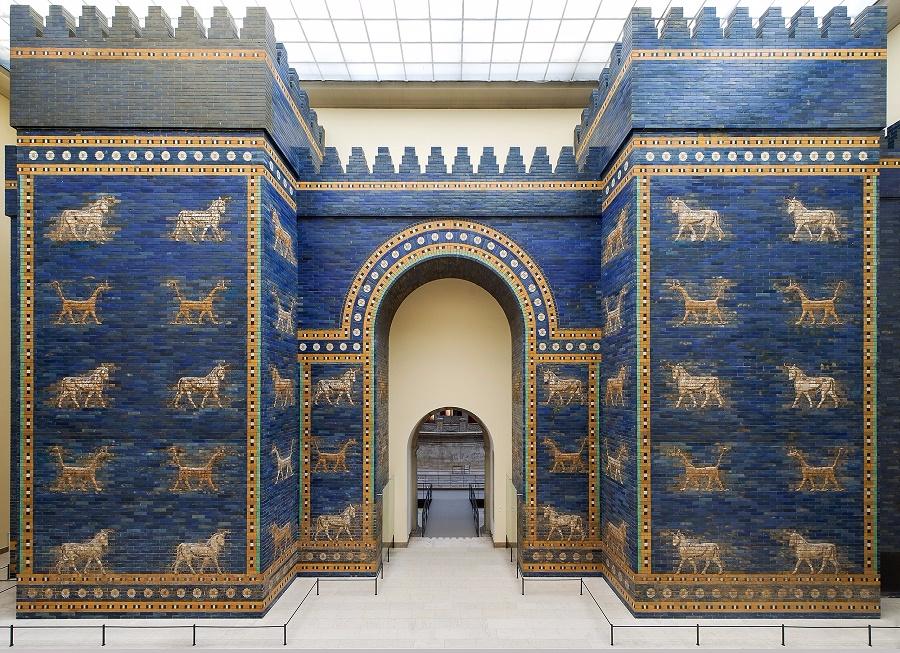
The Ishtar-gate of Babylon in Pergamon Museum. The cultic procession went through this gate.
Battle, creation, enthronement, and justice
The Ishtar-gate of Babylon in Pergamon Museum. The cultic procession went through this gate.
Published September 14, 2014
For translations, descriptions and discussion of the New Year’s festival in Babylon (and in other cities), see A. Sachs, in: J.B. Pritchard, Ancient Near Eastern Texts Relating to the Old Testament2, Princeton 1955, pp. 331-334; M.E. Cohen, The Cultic Calendars of the Ancient Near East, Bethesda MD 1993, pp. 400-453; M.J.H. Linssen, The Cults of Uruk and Babylon: The Temple Ritual Texts as Evidence for Hellenistic Cult Practice (Cuneiform Monographs 25), Leiden 2004, pp. 61-91, 184-237.
See M.J.H. Linssen, The Cults of Uruk and Babylon: The Temple Ritual Texts as Evidence for Hellenistic Cult Practice (Cuneiform Monographs 25), Leiden 2004, pp. 219-220, 228.
For more on this psalm and its connection to Rosh Hashana, see Alan Cooper, “The Psalm of the Shofar: Its Use in Liturgy and its Meaning in the Bible,” TheTorah (2014).